
The $950k Sweet Spot: How First-Home Buyers Are Winning Melbourne’s Unit Market
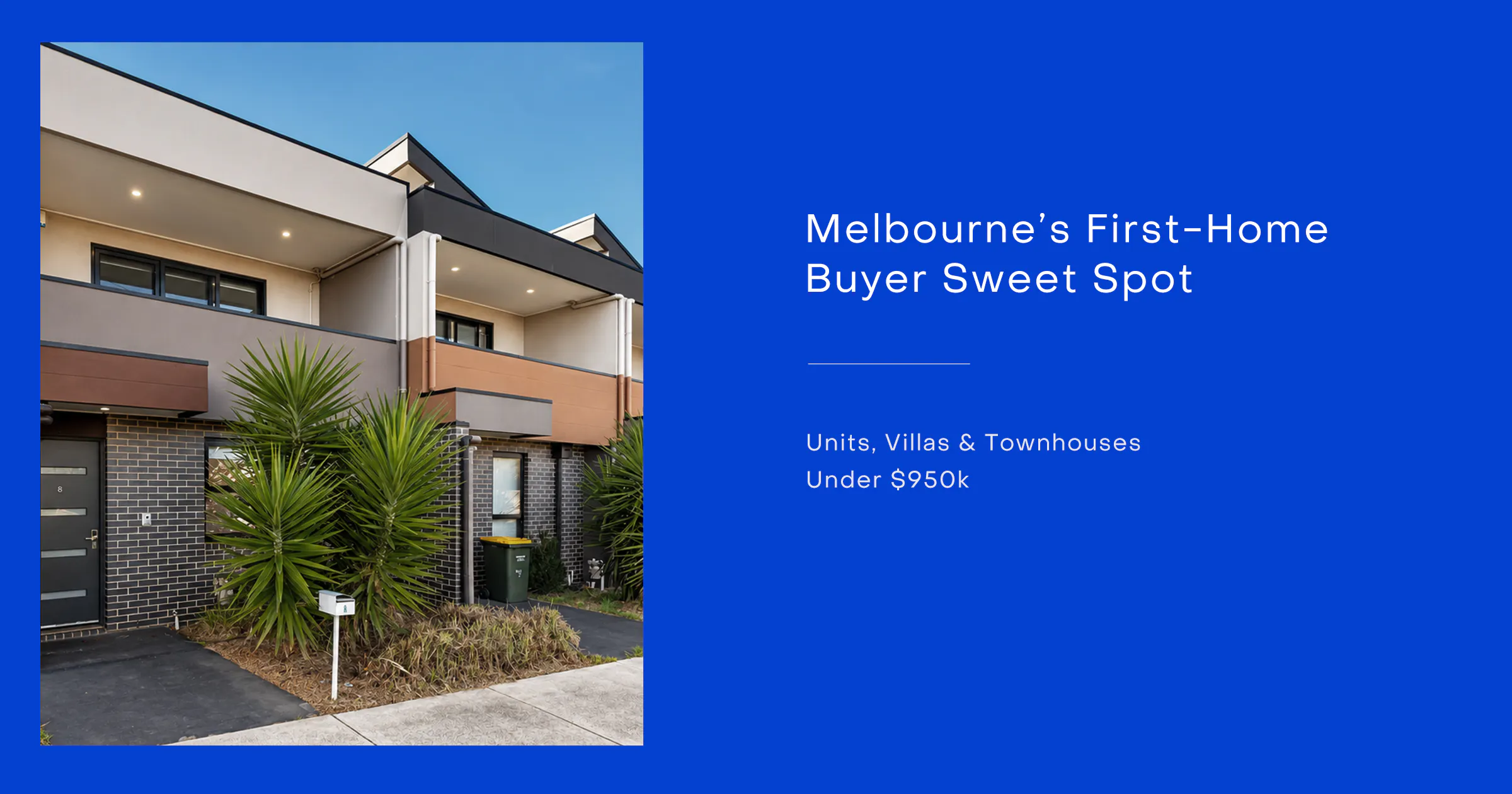
For Melbourne first-home buyers, the $950,000 5% Deposit Scheme cap is a ceiling, not a target. Compare units, villas, townhouses and houses by suburb, stamp duty, ownership costs and resale demand before deciding what fits your budget.
For Melbourne first-home buyers in 2026, $950,000 is an important number — but it should be treated as a ceiling, not a target.
Under the Australian Government 5% Deposit Scheme, eligible buyers can purchase with a minimum 5% deposit without paying Lenders Mortgage Insurance, subject to lender approval and other eligibility requirements. For Melbourne and Geelong, the current property price cap is $950,000. Both the purchase price and the lender-assessed property value must remain within the applicable cap.
That ceiling sits well above much of Melbourne's unit market.
REIV's June-quarter data put the metropolitan Melbourne unit median at $643,500, compared with $952,500 for houses. And in the week ending 12 September 2026, figures reported from REIV results showed units clearing at 75% with a $733,000 auction median.
The following week showed why buyers should not read too much into one clearance-rate headline: My Housing Market data for the week ending 19 September recorded a 63.0% unit clearance rate and $719,000 median auction price.
The bigger story is more useful than either weekly number: a substantial part of Melbourne's unit, villa and townhouse market sits below the federal scheme cap while many houses do not.
For a first-home buyer, that creates a much wider decision than simply asking, “What can I buy for $950,000?”
The better question is:
What type of property gives me the best combination of location, ownership costs, land component, lifestyle and future buyer demand within my actual budget?
What Does the 5% Deposit Scheme Actually Let You Buy?
The Australian Government 5% Deposit Scheme can apply to an existing or new house, townhouse or apartment, as well as certain house-and-land, vacant-land-plus-build and off-the-plan purchases.
For eligible first-home buyers, the basic criteria include being an Australian citizen or permanent resident aged at least 18, having a minimum 5% deposit, buying an owner-occupied home within the relevant property price cap and satisfying a participating lender's credit requirements. A buyer may also qualify if they have not owned property or land in Australia during the previous 10 years. (Check the official eligibility requirements)
There are now unlimited places under the Scheme, and the previous income caps were removed when the expanded scheme commenced on 1 October 2025.
But there is one distinction every Victorian first-home buyer should understand.
$950k Is Not Victoria's Stamp Duty Threshold
The federal $950,000 scheme cap and Victoria's first-home buyer stamp duty thresholds are different.
In Victoria, eligible first-home buyers currently pay:
No land transfer duty on a home with a dutiable value up to $600,000
Reduced duty from $600,001 to $750,000
Normal applicable duty once the first-home buyer concession range has been exceeded
The Victorian State Revenue Office explains the current thresholds in its first-home buyer duty exemption and concession guide.
So a buyer purchasing an eligible $900,000 property may still use the federal 5% Deposit Scheme, but they should not assume they will also receive Victoria's first-home buyer stamp duty concession.
That makes the $600,000–$750,000 range particularly important to model carefully, rather than automatically stretching toward $950,000 just because the federal scheme permits it.
Why Melbourne Units Are Suddenly Part of the First-Home-Buyer Conversation
Melbourne's affordability divide between houses and units has become difficult to ignore.
The REIV recorded a metropolitan Melbourne house median of $952,500 in the June 2026 quarter — essentially at the federal scheme ceiling — while the unit median was only $643,500.
That creates very different options for the same buyer.
A $700,000–$800,000 budget may struggle to secure a conventional house in many established middle-ring suburbs, but it can open up two- and three-bedroom units, villa units, apartments and some townhouses in significantly more established locations.
REIV has also noted the growing role of units and apartments as an entry point into home ownership. In late 2025, its data showed Melbourne's middle-ring unit median at $747,500 and outer-ring unit median at $650,000. (REIV's analysis of Melbourne's growing unit market)
That does not mean “unit beats house”.
It means first-home buyers now have to compare property quality rather than just property category.
Where Can $950k — or Much Less — Still Buy in Melbourne?
The useful opportunities are not confined to Melbourne's outer fringe.
Current REIV suburb data shows several very different markets where property types remain within the scheme ceiling.
Glenroy: Established North With Units Well Below the Cap
In Glenroy, the current REIV data records a median of approximately $670,000 for units, with two-bedroom units around $580,000 and three-bedroom units around $739,500.
The suburb's overall house median is about $902,000, while three-bedroom houses are around $870,000. (REIV Glenroy market data)
That gives first-home buyers an unusually broad choice: villa or townhouse at the lower end, versus some houses as the budget moves toward the federal cap.
Reservoir: Villa and Townhouse Territory
Reservoir illustrates the “villa versus house” decision particularly well.
Its overall house median is currently around $952,000, effectively sitting at the 5% Deposit Scheme's Melbourne ceiling, while the median for units is about $633,000. Three-bedroom units are around $800,000 in the current REIV dataset. (REIV Reservoir market data)
For a buyer deciding between a smaller house farther out and a villa or townhouse closer to established transport and amenities, that price gap changes the equation substantially.
Heidelberg: Location Without the House Price
Heidelberg's current house median is around $1.3 million, putting typical houses well outside the scheme ceiling.
Its unit median, however, is approximately $640,000, with two-bedroom units around $650,000 and three-bedroom stock around $874,000. (REIV Heidelberg market data)
This is an example of how choosing a different property type can give a first-home buyer access to a suburb that would otherwise appear unaffordable based on its house median alone.
Werribee: Where Houses Remain Part of the Conversation
The western corridor produces a different equation.
Werribee's current house median is approximately $680,000, with three-bedroom houses around $625,000 and four-bedroom houses around $730,000. The unit median sits substantially lower at about $473,000. (REIV Werribee market data)
For buyers prioritising land, bedrooms and a family-oriented property type, areas like Werribee can therefore compete directly with villa units much closer to Melbourne.
Craigieburn: House Buying Below the Scheme Ceiling
Craigieburn provides a similar comparison in Melbourne's north.
REIV currently records a house median of around $717,000, with three-bedroom houses around $665,000 and four-bedroom houses around $780,000. Units sit around a $511,000 median. (REIV Craigieburn market data)
The trade-off is obvious: a buyer may be able to secure more land and accommodation than they could closer to the CBD, but commute, infrastructure, future supply and lifestyle need to be weighed against that additional space.
For a broader comparison of price, transport and property types, Forge has also mapped out where first-home buyers can still buy in Melbourne in 2026.
Villa vs House vs Apartment: Which Numbers Actually Matter?
This is where online debates often become too simplistic.
“Buy land.”
“Never buy an apartment.”
“Owners corporation fees are dead money.”
“Buy as close to the city as you can.”
None of those rules is universally reliable.
A useful comparison should look at the complete ownership position.
Buying a House
A house may provide more land, greater control over renovations and, depending on the site, redevelopment potential.
But buying a house simply to avoid an owners corporation can lead a first-home buyer much farther from employment, transport, schools and established amenities.
A larger property also means the owner carries the full cost of its insurance, external maintenance, gardens, roofing and other repairs directly.
Buying a Villa Unit or Townhouse
A villa can sit between a detached house and an apartment.
Older villa units may offer private outdoor space, a garage and some underlying land while remaining within established suburbs where detached houses are already above budget.
But buyers should inspect the subdivision carefully.
Two properties both marketed as “villas” can have completely different owners corporation structures, land allocations, common areas and maintenance responsibilities.
Buying an Apartment
Apartments can provide the lowest entry price into highly established locations, but building quality matters enormously.
Before buying, review the owners corporation certificate, financial statements, maintenance fund, insurance, meeting minutes, major planned works, cladding history and any known disputes or defects.
Owners corporation fees are not automatically a negative.
The relevant question is what those fees pay for.
A low-fee development with an underfunded maintenance plan can expose owners to special levies later. A higher-fee building may simply include lifts, insurance, common-area maintenance and facilities that would otherwise need to be paid for separately.
Forge's guide to Melbourne apartments in 2026 explains why low-rise owner-occupier buildings and investor-heavy high-rise towers can behave very differently in resale markets.
Buyers with accessibility requirements should also look beyond the floorplan itself. Entrances, internal circulation and bathrooms may affect how easily a property can be adapted later; providers such as Mobility Access Modifications illustrate the kinds of ramps, bathroom changes and access modifications that can be relevant when assessing a home's long-term suitability.
Don't Forget the 3–10 Year Resale Question
A first home does not necessarily need to be a forever home.
That makes the future buyer pool important.
When comparing two similarly priced properties, ask:
Who is likely to buy this from me in five or ten years?
A well-positioned two-bedroom villa near transport may appeal to first-home buyers, downsizers and investors.
A one-bedroom high-rise apartment with hundreds of near-identical competing apartments may have a narrower resale proposition.
A four-bedroom house in an outer growth corridor may attract families, but buyers should investigate how much competing new housing supply can still be delivered nearby.
A townhouse in an established middle-ring suburb may sit somewhere between those categories.
Rather than assuming one property type will appreciate faster, compare factors such as:
Scarcity of the property type
Land component
School and transport access
Walkability and local amenity
Owners corporation costs
Building condition
Development pipeline
Comparable resale evidence
Depth of the future owner-occupier buyer pool
This is where buyer advocacy can be particularly useful: the question is not merely whether a property fits below $950,000, but whether its price is supported by comparable sales and whether the asset itself fits the buyer's intended holding period.
Why $950k Can Be a Dangerous Auction Number
There is one final trap for buyers using the 5% Deposit Scheme.
If $950,000 is the applicable property price cap, an auction cannot simply be treated like a normal bidding contest where another $5,000 “won't matter”.
It can matter.
The Australian Government specifies that both the purchase price and the lender-assessed property value need to be at or below the relevant Scheme cap.
A buyer relying on the Scheme therefore needs a clear auction limit before bidding starts.
If a property is already approaching the cap, emotional bidding can turn a Scheme-eligible purchase into one that no longer satisfies the property-price requirement.
That makes auction preparation especially important.
Before bidding, buyers should know:
their lender-approved borrowing position, the relevant Scheme cap, estimated acquisition costs, comparable-sale value and their absolute walk-away price.
Forge's guide to buying smart in Melbourne's softer 2026 market explains how to test advertised prices against comparable sales before an auction rather than allowing the bidding itself to determine what a property is “worth”.
So Where Is Melbourne's Real First-Home-Buyer Sweet Spot?
It is not automatically $950,000.
For some buyers, a $580,000 villa with no first-home buyer stamp duty may produce a much stronger financial position than a $930,000 townhouse bought simply because the Scheme makes it technically possible.
For another household, spending $800,000–$900,000 on a larger townhouse or established home may provide enough additional space to avoid moving again in three years.
And for buyers prioritising land over proximity, Melbourne's outer north and west still contain houses below the federal cap.
The $950,000 ceiling matters because it widens the choice.
It allows first-home buyers to compare houses, villas, townhouses and apartments across a much larger section of Melbourne rather than being forced into a single property type.
But the strongest purchase is still determined property by property.
Use the Scheme cap as a boundary.
Use recent comparable sales to determine value.
Model stamp duty and owners corporation costs separately.
And before competing at auction, know the exact number at which the property stops making sense for you.
That is where the real advantage lies for a Melbourne first-home buyer in 2026.
Forge Real Estate Melbourne can help you blueprint your future by finding the perfect blue-chip property where your lifestyle needs and investment goals converge.
📞 Phone: (03) 91003633
✉️ Email: info@forgeproperty.com.au
🌐 Website: www.forgerealestate.com.au
We offer specialized consultation and can assist in both Mandarin and Cantonese.
Related Articles

Buying a Melbourne Apartment? The Owners Corporation and Inspection Checks Nobody Warns You About
A fast-accepted offer on a Melbourne apartment is not automatically a red flag. Review the owners corporation certificate, meeting minutes, finances, maintenance history, title plan and inspection findings before your contract becomes unconditional.

Melbourne’s New Reserve Price Rule: Why Underquoting Is About to Get Harder to Hide
Victoria’s new reserve price rules begin on 1 October 2026, with disclosure requirements for auctions and fixed-date sales from 16 October. Learn what the changes mean for Melbourne buyers, underquoting concerns, passed-in properties and pre-auction due diligence.

If It’s a Buyers’ Market, Where Are All the Buyers?
Melbourne may be softer overall, but quality family homes can still attract strong competition. This guide explains why suburb differences, comparable sales, school zones, scarcity and auction dynamics matter more than a broad buyers’ market label.