
Melbourne Apartment Strata Red Flags: How to Spot Future Special Levies Before You Buy
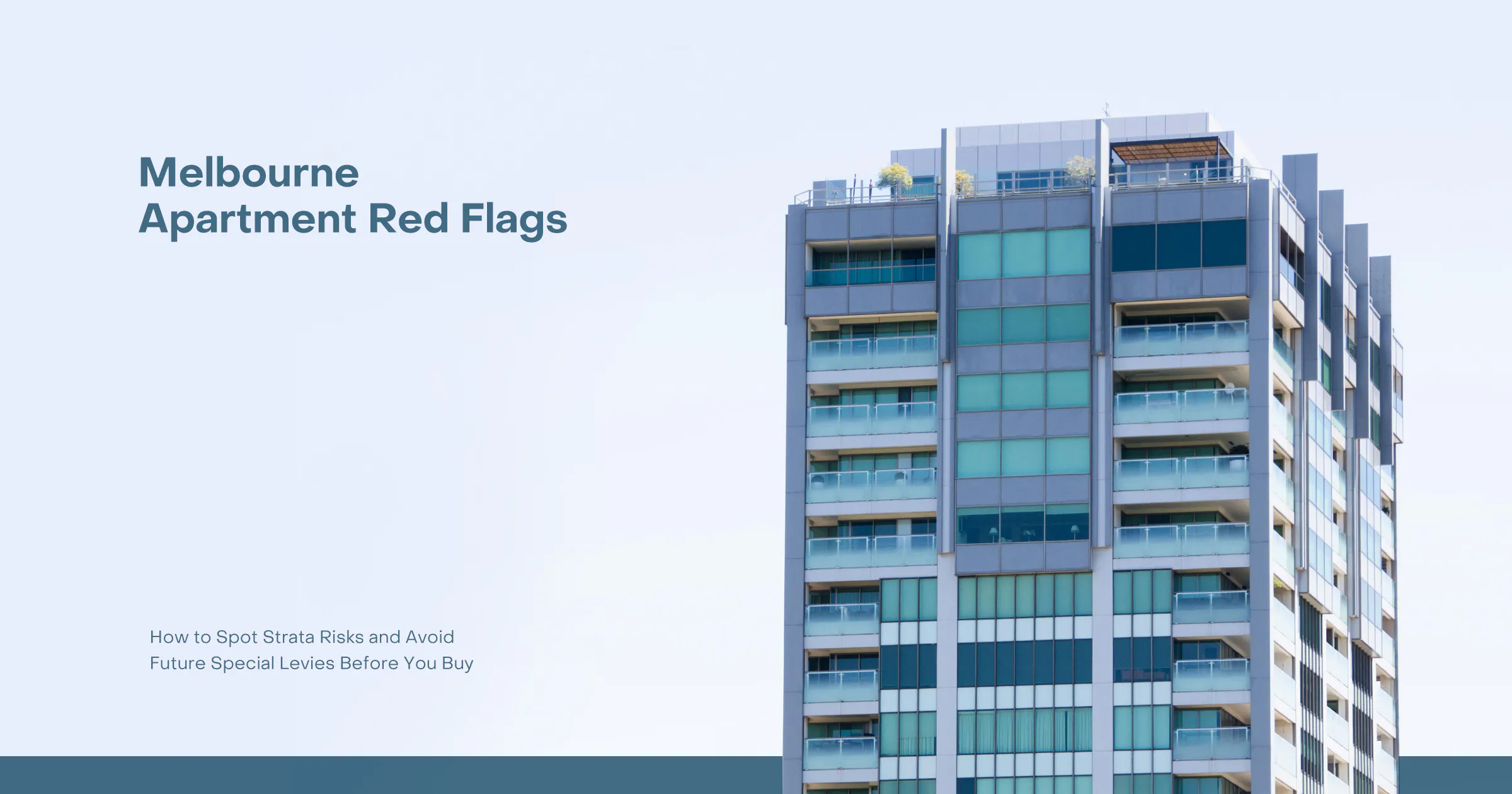
Buying a strata apartment in Melbourne? Before you sign, carefully review the Section 32, Owners Corporation records, and sinking fund balance. This guide explains common defect patterns in 2000s–2010s buildings, what a healthy maintenance fund looks like, and when future special levies are a real risk.
A special levy is an additional charge issued to all owners in a strata building when the Owners Corporation (OC) lacks sufficient funds to cover a major repair — a new roof, lift replacement, or facade rectification. In Melbourne, these levies can range from $10,000 to well over $100,000 per lot depending on the building's size, age, and the severity of deferred maintenance. The best time to identify this risk is before you exchange contracts, by reviewing the OC financial records, meeting minutes, and sinking fund balance included in the Section 32 Vendor’s Statement.
What a Healthy Sinking Fund Actually Looks Like
The sinking fund (also called the maintenance fund) is the long-term capital reserve an Owners Corporation accumulates to fund major works. In Victoria, OCs are required under the Owners Corporations Act 2006 (Vic) to maintain a maintenance plan for buildings with more than 10 lots or an annual budget exceeding $200,000 [the Act sets the legal framework for maintenance plans and financial management of owners corporations].
A rough benchmark: a well-managed building should hold sinking fund reserves equivalent to at least 1–2 years of anticipated major capital expenditure. For a 20-lot building in Melbourne with a lift, common area air conditioning, and an aging roof, that might mean a fund of $150,000–$300,000 is adequate. A fund of $8,000 for the same building is a serious warning sign.
Small blocks of six to ten units carry a specific risk: each lot contributes proportionally less, so any major repair is concentrated across fewer owners. A $120,000 roof replacement split eight ways is $15,000 per owner — often payable within 28 days of a levy notice.
Common Defect Patterns in Melbourne's 2000s–2010s Apartment Stock
Buildings constructed between approximately 2000 and 2018 in Melbourne represent a disproportionate share of strata complaints, partly due to a period of rapid construction and inconsistent oversight before the Victorian cladding audit regime tightened following the Victorian Government’s cladding taskforce and rectification programs administered through Cladding Safety Victoria.
Recurring issues in this era include:
Waterproofing failures affecting basement carparks, balconies, and common area roofs. Water ingress in underground carparks is one of the most frequently cited issues in Melbourne OC meeting minutes and is expensive to rectify properly.
Mould and ventilation deficiencies, particularly in one-bedroom apartments with limited cross-ventilation. In Victoria, mould caused by structural defect (not tenant behaviour) may trigger obligations under the Residential Tenancies Act 1997 (Vic) and associated minimum rental standards if the property is leased.
Cladding liability, where buildings are subject to rectification orders from the Victorian Building Authority or are on the Cladding Safety Victoria register. Some rectification costs are government-supported, but not all, and unresolved cladding liability can affect insurability and resale value significantly.
Lift and mechanical plant aging, most acute in buildings constructed before 2005 where original equipment is approaching end-of-life. A single lift replacement in a mid-rise Melbourne building typically costs $80,000–$150,000.
How to Read OC Records Before You Bid
The Section 32 must include an Owners Corporation certificate disclosing current levies, arrears, and any known legal proceedings, as required under the Sale of Land Act 1962 (Vic) and related disclosure requirements.
Beyond the certificate, request the last two years of OC meeting minutes and the current maintenance plan.
In the minutes, look for: repeated references to the same unresolved defect, mentions of engineering or quantity surveyor reports being commissioned, disputes between the OC committee and the building manager, and any notation of legal action — particularly against a developer or builder under statutory warranty.
A single reference to a leak is not automatically disqualifying. Repeated entries across multiple meetings with no resolution, or a special levy resolution that has already been passed, indicate a building in reactive rather than planned maintenance mode.
When to Walk Away — and When "Ugly" Is Actually Fine
Older Melbourne apartment blocks — think 1960s–1970s brick walk-ups in Prahran, Elsternwick, or Northcote — often carry lower defect risk than their appearance suggests. Brick construction, simple rooflines, and no lifts or complex mechanical systems mean fewer catastrophic failure points. These buildings frequently have modest but adequate sinking funds relative to their actual maintenance needs.
The calculus shifts with complexity. A 2012-built high-rise with a rooftop pool, two lifts, and a gym presents multiple high-cost liability vectors, even if the sinking fund looks adequate today.
A useful rule: assess the fund not just in dollar terms, but against the building's known and foreseeable capital obligations over the next ten years.
In some buildings, accessibility improvements — such as compliant entry ramps, safer bathroom layouts, or step-free access to common areas — may also arise as future capital works projects. Specialist providers like Mobility Access Modifications work with Melbourne property owners and strata environments to design and install accessibility upgrades that meet mobility and ageing-in-place needs.
How a Specialist Can Help
Forge Real Estate assists buyers with pre-purchase strata due diligence — reviewing OC records, flagging patterns in meeting minutes, and contextualising financial data against Melbourne suburb and building-era benchmarks. For investors already holding strata property with emerging defect risk, the team can assess whether renegotiating, holding through rectification, or repositioning into a lower-risk asset class is the more rational long-term strategy.
Forge Real Estate Melbourne can help you blueprint your future by finding the perfect blue-chip property where your lifestyle needs and investment goals converge.
📞 Phone: (03) 91003633
✉️ Email: info@forgeproperty.com.au
🌐 Website: www.forgerealestate.com.au
We offer specialized consultation and can assist in both Mandarin and Cantonese.
Related Articles

Melbourne's Buyer's Market 2026: How Much Room Is There to Negotiate $20k–$50k Off Asking?
Yes, in most of Melbourne's inner-city and middle-ring suburbs in mid-2026, offers $20,000–$50,000 below the asking price are realistic and often accepted—provided they're supported by comparable sales rather than guesswork. Melbourne has clearly shifted…

Sold at Auction — or Was It? Understanding Underquoting, Dummy Bids and Your Rights at a Melbourne Auction
Buying at auction in Melbourne is governed by strict Victorian laws designed to protect buyers and promote transparency. Real estate agents must provide a Statement of Information (SOI) with a genuine estimated selling price and three comparable recent sales,…

Buying an Apartment or Unit in Melbourne: Are Strata and Owners Corporation Fees a Trap or a Smart Entry Point?
Buying an apartment or unit in Melbourne isn't inherently a poor investment. While some apartment markets have softened, the biggest risk is rarely the property type itself—it's buying into a poorly managed Owners Corporation (OC) with inadequate financial…